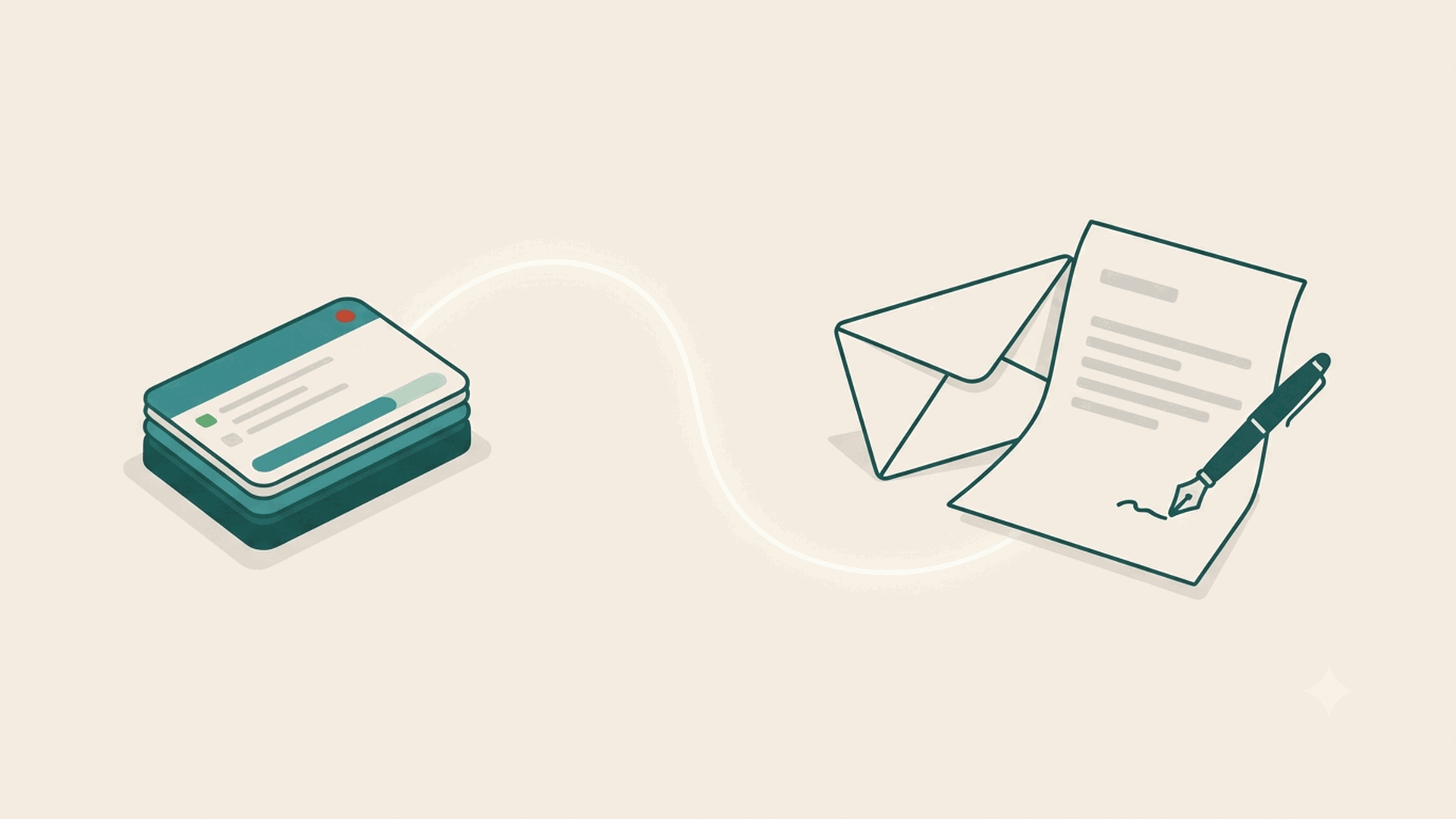
It is Friday afternoon and someone on your team is writing the same email again. Hi, quick update on where things stand. The design is with the client for review, development starts Monday, we are still waiting on the copy, launch is tracking to the end of the month. It takes forty minutes across a few clients, it is nobody’s favourite task, and you cannot bill a minute of it. Next Friday, they will write it again.
That email is not the problem. It is a symptom of a specific one, and it is worth naming, because once you see it you will stop paying for it.
You are transcribing your own tool
Look at what actually goes into that update. The person writing it opens the project, reads the current state off the board, and types it into an email in slightly nicer words. Every fact in the email already exists in the tool. The deadlines are in there. What is blocked is in there. What moved this week is in there. The email is not creating information. It is copying information out of a system that has it, into a format a client can read, by hand.
That is the whole cost. Not thinking, not judgment, just transcription. A person is being paid, or rather not paid, to be a human export button between the tool your team uses and the inbox your client checks. Do that across ten clients every week and it is a part-time job that produces nothing new.
Why it stays manual
The obvious question is why the tool doesn’t just do this. Because most project tools are built for the team, not the client. Their sharing options are all-or-nothing: either you give the client a login and let them wander your internal boards, comments and half-finished tasks, or you give them nothing and keep exporting by hand. Neither is acceptable for client work, so agencies pick the safe one, which is the manual one. The Friday email exists in the gap between a tool that has the status and a tool that will present it to an outsider safely.
The cost is not just the hours
The unbillable time is the visible cost. The quieter one is what the manual update does to the relationship. Because it is written by hand, it goes out when someone has time, which means it goes out late when the week is busy, which is exactly the week the client most wants to know where things are. And because a human is choosing the words, the update drifts toward the comfortable version. The slipping thing gets softened, the awkward dependency gets left out, and the client finds out about the problem later than they should have, from a person who technically already knew. Manual status reporting is not just slow. It is editable, and clients can feel it.
Let the work become the update
The fix is to stop treating the client update as a thing someone writes and start treating it as a view of the work you are already doing. SRP generates a client portal automatically from the same projects your team works in. Progress, milestones, what is on track and what is at risk, the files that are ready to share, all of it drawn from the real state of the work and nothing else. It is passcode-protected, so the client sees their project and only their project, not your internal mess. And because it reads from the work rather than from someone’s Friday energy, it is current on Friday, and Tuesday, and any other time the client looks, without anyone writing a word.
The same risk engine that tells your team what is slipping is what tells the client, which means the internal truth and the external update are finally the same thing. No double entry, no softened version, no forty minutes you cannot bill.
For an agency, that is not a small convenience. It is hours back every week, an update that never goes out late, and a client who trusts the status because it is not being narrated to them. The status email was always just the work, retyped. Stop retyping it.