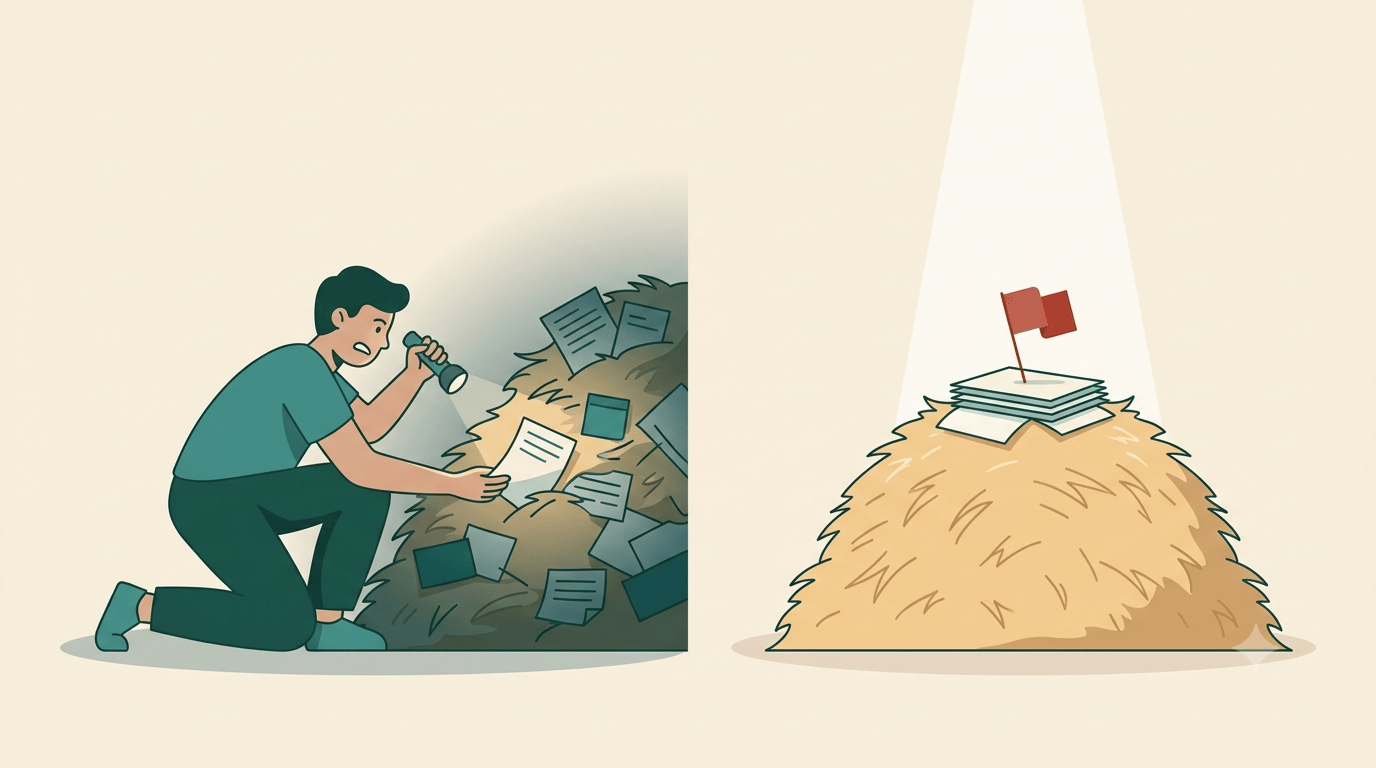
Here’s a lens that, once you have it, you can’t put down. Every project tool ever made falls into one of two camps. Not by price, not by how many views it has, not by which team it’s aimed at, but by one thing: what happens when you want to know what’s falling behind.
In the first camp, the answer exists somewhere inside the tool, and it’s your job to go get it. In the second, the tool works the answer out and hands it to you. Call them pull and push. Sort any tool you’ve used into those two buckets and something uncomfortable becomes obvious: almost the entire category is pull, and the push side is nearly empty.
Pull is the water the whole category swims in
A pull tool is a very good place to put work. Tasks, boards, dates, assignees, statuses, comments, all stored, all searchable, all there. What it will not do is reach a conclusion for you. Ask “what’s at risk this week?” and the honest shape of the answer is: it’s in here somewhere. Behind a filter you have to build. In a report you have to configure. On the fourth board you haven’t opened yet. In the burndown chart, if you know how to read it. In someone’s head, if you remember to ask them.
None of that is a defect in any one product. It’s the shared assumption underneath all of them: a human keeps the status current, and a human goes looking for problems. The board shows an overdue task, but only once you scroll to it. The card says “In Progress,” but only because someone typed that, and only until it stops being true. The tool is a filing cabinet with excellent drawers. Filing cabinets don’t notice anything.
This is also why the status meeting exists. Strip away the calendar invite and a status meeting is just the pull query, run out loud, with the whole team as the search index. “Where are we with this? Is that still blocked? Did the client reply?” You’re not coordinating. You’re manually executing a database lookup the software could have run, because the software won’t run it on its own. The meeting is the clearest proof that the tool is a pull tool: if it pushed, you wouldn’t need to convene people to find out what it already knows.
Pull isn’t chosen, it’s baked in
The natural question is: if push is better, why doesn’t every tool just add it? Because pull isn’t a feature they chose. It’s a consequence of how their data is shaped, and you can’t patch your way out of your own data model.
In a pull tool, status is a field a person edits. “On Track,” “At Risk,” a percent-complete number, a colored label. That field can only ever hold what someone last typed into it. It cannot conclude anything, because there’s nothing behind it doing the concluding. It’s a text box wearing a traffic-light costume. So “is this at risk?” can never be answered by the system. It can only be answered by whoever remembers to keep the box current, which at any real volume nobody does, which is why the board quietly starts lying: it says “on track” because that’s the last thing someone typed, not because anything checked.
Bolting real risk detection onto that is not a feature flag. It means changing what “status” fundamentally is, from a thing people declare to a thing the system derives, and that re-teaches every existing customer’s data. It’s a migration, not an update. There’s a business reason too: most of the category grows by adding surface area, more views, more fields, more apps to absorb. “Do less, but conclude more” runs directly against that. So the incumbents don’t stay pull out of laziness. They stay pull because push would make them a different kind of company.
Push is a different category, not a faster pull
A push tool starts from the opposite premise: the conclusion is the product, and the software’s job is to reach it. So status isn’t typed, it’s derived. A task is blocked because it actually has an open blocker, not because someone labeled it. It’s overdue because a date genuinely passed. A decision is stale because it hasn’t moved in a meaningful stretch of the work’s life. An iteration is off-track because the numbers say so. The tool computes these continuously, rolls them up, and puts the result in front of you: this is slipping, and here’s the chain of why.
The difference you feel is the direction of effort. With pull, you open the tool and start hunting. With push, you open it and it’s already answered. You didn’t run the query; the query ran itself and came to find you. That’s not pull but quicker. It’s the other camp entirely, and it’s the one almost nobody is in.
Push is normal everywhere except here
You won’t find many push tools in project management, and that’s the point, not a hole in the argument. Push barely exists in this category. But it isn’t exotic; it’s how the software right next door already works. Your monitoring stack pages you when a server is sick. Your error tracker emails you the stack trace before a user has to complain. Your uptime monitor texts you the moment the site goes down. Your build pipeline shouts the instant something breaks. None of them wait for you to log in and go looking. Project management is the odd one out, the category that still expects you to come dig for what it already knows.
What push does not mean
Worth being clear, because this category is full of overpromises. Push does not mean the tool runs your projects, takes you out of the loop, or catches literally everything. It can’t, and anyone selling that is selling. You still read the signals and decide what to do about them, who to call, what to cut, what to tell the client. The judgment is yours, and it’s the part worth your time. What push removes is the hunting: the manual labor of assembling the answer by hand every morning. It flips the default from “go find out what’s behind” to “you’ll be told while there’s still time to fix it.” That’s a smaller, more honest promise than most of the category makes, and it’s the whole point.
How to tell which one you have
You don’t need a spec sheet. Ask one question: to find out what’s at risk right now, do I go to the tool, or does the tool come to me? If the answer involves opening boards, building a filter, reading a chart, or calling a meeting, you have a pull tool, no matter how polished it is. If the answer is already on the screen when you arrive, with the reason attached, you have a push one.
That’s the camp SRP was built to occupy. It derives health from the work itself and surfaces what’s slipping, so the question stops being something you chase and becomes something you’re handed. If you’ve spent years in tools that made you dig, it’s a strange feeling the first time the answer is just there, waiting for you instead of the other way around.