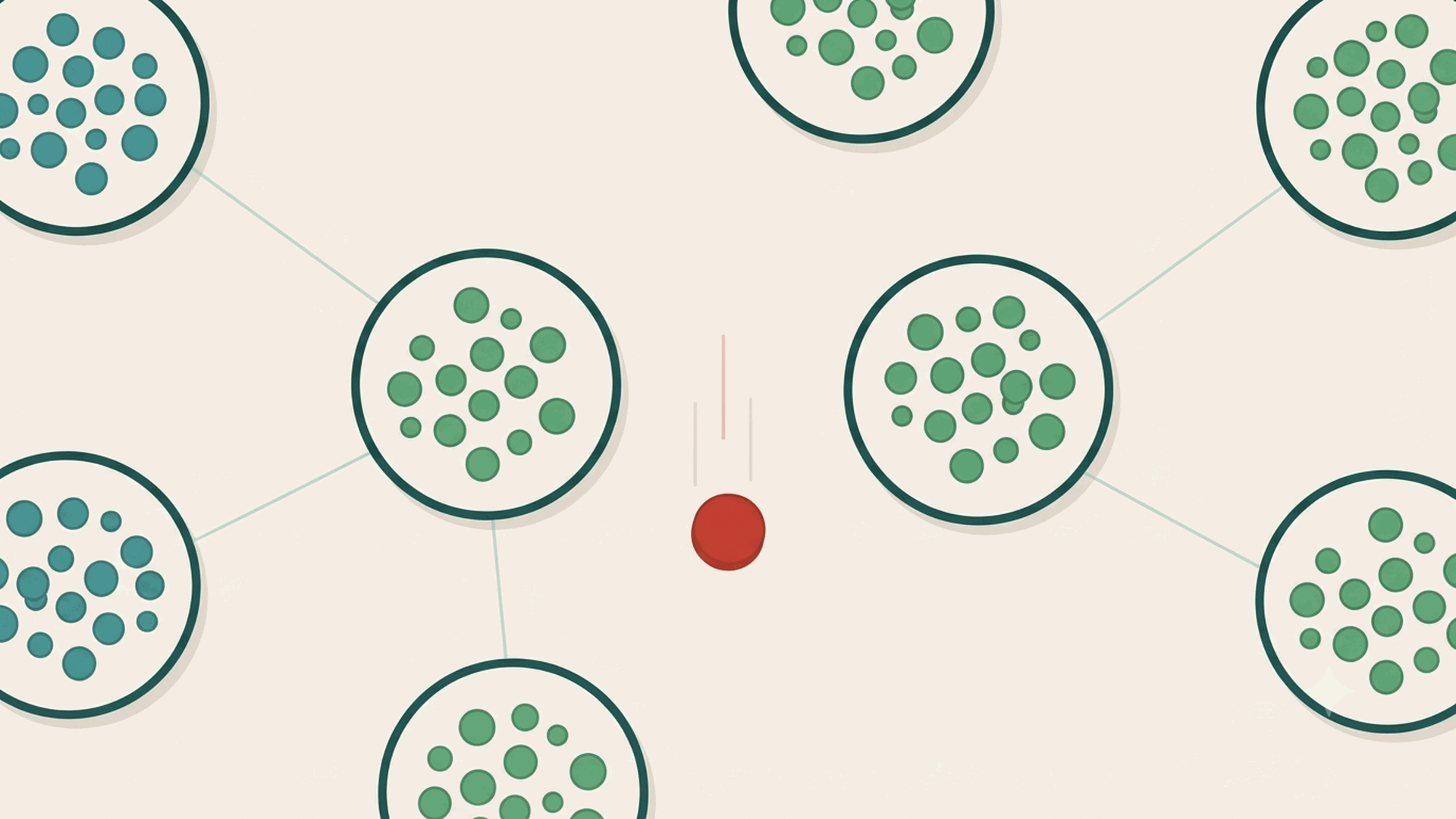
On one team, good ceremony works. The daily standup surfaces what is stuck, refinement keeps the next work ready, the retro fixes what went wrong last time. Run those well and nothing gets left behind, because the team is small enough that the rituals touch every piece of work. Anyone who calls agile ceremony theatre has not seen it done well on a team that needed it.
Then you get handed a second team. And a third. And the thing that quietly breaks is not the ceremony. It is the assumption that it scales.
Ceremony covers a team, not a portfolio
A standup does not keep a team on track because standups are magic. It works because one person, for fifteen minutes, holds the whole of one team’s work in their head and walks it. The coverage comes from a human paying full attention to a bounded amount of work. That is why it feels airtight on one team, and exactly why it does not survive being multiplied.
Across five teams you cannot be in five standups, so nobody is holding each team’s work anymore. Each team is still disciplined, each ceremony still runs, and yet the thing you used to guarantee, that nothing slipped through, no longer has anyone doing it. The rituals did not fail. They just never covered the space between teams, because that space was never a team’s job.
The gaps move to the seams
On one team, almost everything that matters happens inside the team, so the ceremony catches it. Scale up and the risky work moves to the joins. The deliverable that needs one team to finish its piece and another to sign it off. The dependency that crosses from the team that owns it to the team waiting on it. No standup owns that handoff, because it belongs to no single team. Five healthy standups can all report green while the thing spanning them slips, and every team is telling the truth.
That is what people miss when they say scaling is hard. It is not that the teams got worse. The coverage you had was per-team, and the failures moved somewhere no single team was looking.
You cannot just run more ceremony
The instinct is to add process. A standup of standups, a weekly cross-team sync, a program board somebody keeps current. Sometimes that helps. Often it just moves the problem up a level, because now one person has to hold five teams’ work in their head for that meeting, and no one can, so you get the same summary of a summary and the same blind spots, only with more meetings. That is the real theatre: a ritual that looks like coverage without providing it.
The honest goal is not more ceremony. It is coverage of the seams that does not depend on a person being in every room.
Roll the work up, not the meetings
The seams need what a standup gives a team: something watching the whole of it, all the time. A person cannot do that across five teams. A tool can, but only if it reads the work itself instead of waiting to be told.
That is the idea behind initiatives in SRP. An initiative ties the work behind one outcome into a single thing, across every team. Watched as one chain instead of four separate boards, that deliverable from earlier, one team’s piece plus another team’s sign-off, shows up as a risk to the whole outcome the moment the sign-off stalls, while every individual board still reads green. Something is finally looking at the seam.
And it happens without anyone reporting it. The risk is read from the work, the dates, the blockers, the dependency that went quiet, so covering the seams no longer depends on five teams each remembering to raise a problem that belongs to none of them.
So scaling from one team to five is not about copying five teams’ worth of discipline into your calendar. It is about no longer being the coverage yourself. Keep the standups that earned their place, and stop asking them to watch a space they were never built to see.